
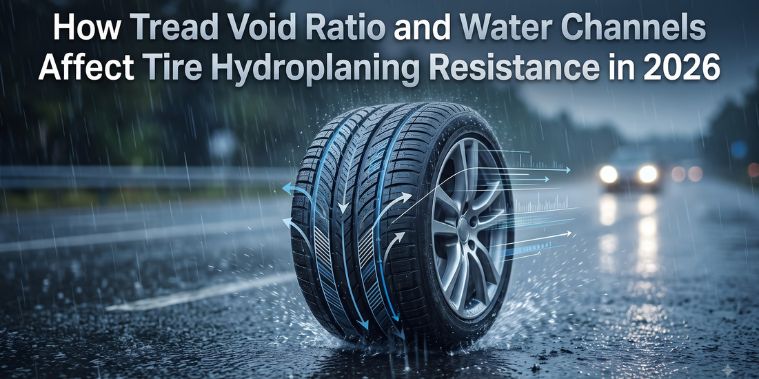
Driving on wet roads requires tires that can maintain reliable contact with the pavement while moving water away from the contact area. When water accumulates between the tire and road surface, the risk of hydroplaning increases, potentially reducing steering control and braking effectiveness. Tread void ratio and water evacuation channels play important roles in managing this challenge. Understanding these design features helps drivers compare all season tires and evaluate Wet Road Performance Tires when choosing suitable tires for changing weather conditions in 2026.
What Is Tire Hydroplaning?
Hydroplaning occurs when a tire cannot displace water quickly enough to maintain adequate contact with the road. A layer of water can build beneath the tread, reducing traction and making steering or braking less responsive.
The risk depends on several factors, including vehicle speed, water depth, tire condition, inflation pressure, tread design, and road surface texture. Worn tread and excessive speed can make wet-road driving particularly dangerous.
Although no tread pattern can eliminate hydroplaning risk, a well-designed tire can help channel water away from the contact patch and maintain better road contact under suitable driving conditions.
Understanding Tire Tread Void Ratio
Tread void ratio refers to the proportion of open space within a tire’s tread pattern compared with the total tread area. These open spaces include grooves and channels that provide pathways for water and debris.
A higher void ratio generally provides more open space for water movement, while a lower void ratio provides more rubber contact area under suitable conditions. Tire engineers balance these characteristics to achieve the required combination of wet traction, dry-road handling, noise control, and tread durability.
For example, a tire designed primarily for wet conditions may feature wider grooves and more pronounced channels to improve water evacuation. However, simply increasing the void ratio does not automatically produce better performance. Groove arrangement, tread depth, rubber compound, and contact patch design also influence the final result.
How Water Evacuation Channels Improve Wet-Road Traction
Water evacuation channels guide water away from the tire’s contact area as the wheel rotates. Their shape, depth, direction, and positioning influence how effectively the tread manages water.
- Circumferential Grooves: These are continuous or nearly continuous channels running around the tire. They help collect and move water along the tread, reducing the amount of water trapped beneath the contact patch.
- Lateral Grooves: Lateral grooves extend across the tread and help direct water toward the outer edges. Their arrangement can support water displacement during straight-line driving and cornering.
- Angled and Directional Channels: Some tread patterns use angled channels to guide water toward the shoulder areas. Directional designs are developed to move water in a preferred direction as the tire rotates. Correct mounting orientation is important for tires marked with a rotation direction.
- Sipes and Smaller Tread Features: Sipes are narrow cuts within tread blocks. They can create additional biting edges and support traction on wet or slippery surfaces. Their contribution depends on the tread design and rubber compound.
Together, these features help manage water flow and support traction, although their effectiveness varies with road conditions and tire wear.
Why Tread Design Matters When Choosing All Season Tires
All season tires are developed to provide a balanced performance across a range of everyday driving conditions. Their tread patterns generally combine circumferential grooves, lateral channels, tread blocks, and sipes to support traction on dry and wet roads.
However, all-season performance varies between tire models. Some prioritize longer tread life and comfort, while others emphasize wet braking, handling, or light winter capability.
Drivers should compare wet traction ratings, manufacturer specifications, independent test results, and the tire’s suitability for their local climate. All-season tires are not automatically suitable for severe winter conditions, where dedicated winter tires may provide better performance.
What Makes Wet Road Performance Tires Different?
Wet Road Performance Tires are designed with particular attention to grip, braking response, and handling on wet surfaces. Depending on the model, manufacturers may use specialized rubber compounds, optimized tread blocks, and carefully positioned water evacuation channels.
Important features to compare include:
- Groove depth: Helps determine how much space is available for water movement.
- Channel arrangement: Influences how water travels through the tread.
- Rubber compound: Affects grip and flexibility across different temperatures.
- Tread block stability: Supports steering response and contact consistency.
- Wet braking performance: Indicates how effectively a tire can stop on wet surfaces under specified test conditions.
Buyers should review actual manufacturer specifications and independent test results instead of assuming that a particular tread appearance guarantees superior wet performance.
How Tire Wear Affects Hydroplaning Resistance
Even an advanced tread pattern can lose some of its water-management capability as the tire wears. As tread depth decreases, the available space inside grooves becomes smaller, which can reduce the tire’s ability to evacuate water.
Uneven wear can also affect performance. Incorrect inflation pressure, poor wheel alignment, worn suspension components, and irregular rotation patterns may contribute to uneven tread deterioration.
Drivers should inspect tread depth regularly, follow the vehicle manufacturer’s inflation recommendations, and replace tires when they reach the applicable legal or safety limits. Tire pressure should be checked when the tires are cold.
Final Thoughts
Hydroplaning resistance depends on several interacting factors, including tread void ratio, water evacuation channels, rubber compounds, tread depth, and road conditions. Circumferential grooves, lateral channels, and directional patterns help move water away from the contact patch and support wet-road traction.
When comparing all season tires and Wet Road Performance Tires in 2026, drivers should consider verified wet braking performance, tread design, climate requirements, and proper maintenance. Choosing suitable tires and adjusting driving speed to road conditions remain essential for safer wet-weather journeys.
