
Tire performance depends on more than tread design and rubber compound. The way pressure is distributed across the tire’s contact footprint also influences how effectively a vehicle can transfer steering, braking, and acceleration forces to the road. Drivers comparing the best tires for car applications should consider how a tire maintains an effective contact patch under different loads and driving conditions. Similarly, properly selected all season tires can provide balanced performance across changing temperatures and everyday road surfaces when correctly matched to the vehicle.
What Is Tire Footprint Pressure Distribution?
The tire footprint, or contact patch, is the area where the tire physically meets the road. Pressure is not necessarily distributed evenly throughout this area. It can change depending on factors such as:
- Tire inflation pressure
- Vehicle weight
- Tire construction
- Wheel alignment
- Road surface
- Cornering forces
- Braking forces
- Tire temperature
When pressure is distributed appropriately, the tire can maintain effective contact with the road during different driving conditions.
Why Contact Pressure Matters for Tire Performance
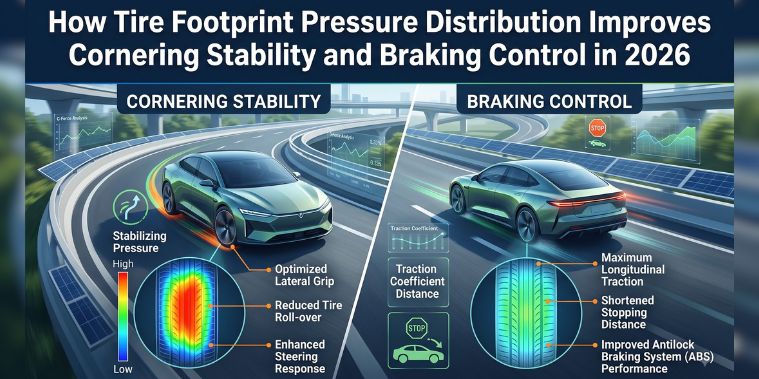
A tire transfers forces through its contact patch. During braking, the tire must transmit longitudinal forces to the road. During cornering, it must generate lateral forces. If the footprint becomes uneven or overloaded in certain areas, the tire may not use its tread surface efficiently.
Balanced pressure distribution can help support:
- Predictable steering response
- Consistent braking
- Even tread loading
- Stable cornering
- Controlled tire wear
This makes footprint behavior an important consideration when evaluating modern tire performance.
How Pressure Distribution Affects Cornering Stability
During a corner, vehicle weight shifts toward the outside tires. This changes the load carried by each contact patch. The outer tires may experience significantly greater loading than the inner tires. Tire construction and pressure distribution influence how effectively the contact patch responds to these changing forces.
A well-designed tire can maintain a useful footprint as lateral forces increase, helping provide predictable steering feedback. Drivers may notice this through:
- More consistent cornering response
- Better steering precision
- Improved directional stability
- Reduced feeling of excessive tire deformation
However, actual cornering performance depends on the vehicle, suspension, alignment, road surface, speed, and tire condition.
Footprint Distribution and Braking Control
Braking places substantial longitudinal forces on the tires. During hard braking, the vehicle’s weight shifts forward, increasing the load on the front tires. An effective contact patch helps the tire maintain road contact while transferring braking forces.
Uneven footprint pressure can contribute to irregular tread loading, which may affect braking consistency and tire wear. Proper tire inflation and correct vehicle maintenance are therefore important for maintaining predictable braking behavior.
The Role of Tire Inflation Pressure
Inflation pressure is one of the most important factors affecting the tire footprint. Underinflation can increase sidewall flex and alter the shape of the contact patch. Overinflation can change how the tread contacts the road.
Both conditions may affect:
- Handling
- Braking
- Ride comfort
- Tread wear
- Rolling resistance
Drivers should follow the vehicle manufacturer’s recommended cold inflation pressure rather than relying on the maximum pressure printed on the tire sidewall.
How Alignment Influences Footprint Loading
Wheel alignment also affects how pressure is distributed across a tire. Incorrect camber, toe, or other alignment conditions can cause certain areas of the tread to carry more load than others.
Possible consequences include:
- Uneven tread wear
- Reduced handling consistency
- Steering pull
- Irregular tire loading
- Reduced tire service life
Regular alignment checks can help maintain more consistent contact between the tire and road.
All Season Tires and Balanced Performance
Modern all season tires are designed to provide a compromise between different weather and road conditions. Their construction, tread design, and compound are engineered to operate across a broader temperature range than specialized seasonal tires.
Footprint pressure distribution contributes to how these tires behave during:
- Dry-road cornering
- Wet braking
- Highway driving
- Light winter conditions
- Everyday commuting
Actual performance varies according to the tire model, vehicle, climate, and road conditions.
Tire Construction and Contact Patch Behavior
A tire’s internal construction influences how its footprint changes under load. Components such as:
- Casing structure
- Belt package
- Sidewall construction
- Tread compound
- Tread pattern
Work together to determine how the tire responds to steering and braking forces. Modern tire development uses testing and modeling to evaluate how these characteristics affect contact pressure and overall road performance.
How Tire Wear Changes Pressure Distribution
As tread wears, the shape and behavior of the contact patch can change. Uneven wear may indicate that pressure, alignment, suspension, or load distribution needs attention.
Common wear patterns include:
- Center wear
- Shoulder wear
- Feathering
- Cupping
- Irregular localized wear
Drivers should investigate unusual wear rather than simply replacing tires without identifying the underlying cause.
Choosing the Best Tires for Different Vehicles
When searching for the best tires for car applications, drivers should consider more than brand or price.
Important factors include:
- Vehicle specifications
- Tire size
- Load index
- Speed rating
- Driving environment
- Climate
- Typical road surfaces
- Expected mileage
- Seasonal requirements
A tire that performs well on one vehicle may not provide the same characteristics on another because suspension setup, weight, alignment, and drivetrain configuration differ.
Maintaining Consistent Footprint Performance
Drivers can take several practical steps to support proper tire contact.
- Check Tire Pressure Regularly: Measure pressure when tires are cold and follow the vehicle manufacturer’s recommended specification.
- Maintain Wheel Alignment: Have alignment checked when uneven wear or steering issues appear.
- Inspect Tread Condition: Monitor tread depth and look for unusual wear patterns.
- Rotate Tires as Recommended: Following the vehicle manufacturer’s tire rotation schedule can promote more uniform wear where rotation is applicable.
- Avoid Excessive Overloading: Excessive vehicle loads can significantly change tire loading and contact pressure.
Why Footprint Pressure Distribution Matters in 2026
Modern vehicles increasingly combine higher power outputs, advanced braking systems, heavier electronic equipment, and sophisticated suspension systems. Tires remain the primary point of contact between these systems and the road.
Understanding footprint pressure distribution helps explain why tire selection, inflation, alignment, and maintenance all contribute to handling and braking performance.
Final Thoughts
Tire footprint pressure distribution plays an important role in how effectively a tire transfers cornering and braking forces to the road. Maintaining appropriate inflation pressure, correct wheel alignment, even tread wear, and suitable tire specifications can help support predictable vehicle behavior.
Drivers researching the best tires for car applications should evaluate tire size, load requirements, climate, driving conditions, and vehicle specifications rather than relying on a single performance characteristic. For drivers seeking year-round versatility, properly selected all season tires can provide balanced performance across a variety of everyday conditions.
Ultimately, tire condition and maintenance remain just as important as tire design. A properly maintained contact patch can help support stable cornering, controlled braking, and consistent road performance throughout the tire’s service life.
