
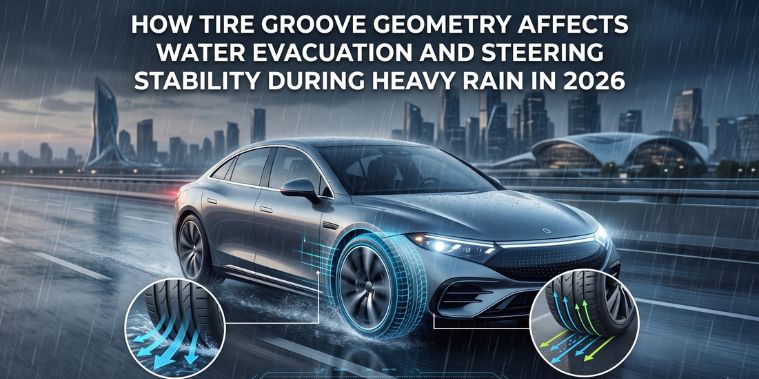
Heavy rain can quickly reduce road grip, making tire tread design an important factor in maintaining traction and steering control. Groove geometry determines how efficiently a tire channels water away from the contact patch while also influencing tread stability and handling response. Drivers comparing mud terrain tires with Wet Road Performance Tires should understand how groove width, depth, direction, and placement affect water evacuation and vehicle control during heavy rainfall in 2026.
What Is Tire Groove Geometry?
Tire groove geometry refers to the shape, size, orientation, depth, and arrangement of grooves within a tire’s tread pattern. These grooves create channels through which water can move as the tire rolls across a wet road.
Different tires use different groove configurations because they are designed for specific driving environments. A highway tire may emphasize water evacuation and stable road contact, while mud terrain tires typically use more aggressive tread patterns designed to move through loose surfaces such as mud, dirt, and gravel.
Why Water Evacuation Matters During Heavy Rain
When a tire travels across a wet road, water can accumulate between the tread and pavement. If the tread cannot move sufficient water away from the contact area, the tire may experience reduced road contact.
Effective groove geometry provides pathways for water to move away from the central contact region. This helps the tread maintain contact with the road surface and can support more predictable braking, acceleration, and steering.
How Main Grooves Channel Water
The larger longitudinal grooves found on many road-oriented tires provide primary channels for water evacuation. Their width and placement influence how efficiently water moves through the tread.
Well-designed main grooves can direct water toward the sides of the tire as it rotates, reducing the amount of water retained beneath the tread. However, groove dimensions must be balanced with the amount of rubber remaining in the contact area because tread design involves trade-offs between wet traction, stability, noise, and wear.
The Role of Lateral Grooves
Lateral grooves run across or diagonally through tread blocks and interact with the primary longitudinal channels. Their orientation can help move water sideways while also creating additional edges that interact with the road.
A coordinated combination of longitudinal and lateral grooves can create an interconnected drainage network. This becomes particularly useful during heavy rain when large amounts of water must be displaced quickly.
Groove Depth and Wet-Road Performance
Tread depth can influence a tire’s ability to maintain drainage pathways as the tire wears. As tread depth decreases, the available space for water movement can also change.
This is why regular tread inspections are important for drivers who frequently encounter heavy rainfall. Drivers looking for Wet Road Performance Tires should consider the complete tread design rather than focusing only on advertised groove depth.
How Groove Geometry Influences Steering Stability
Water evacuation is only one part of wet-road handling. The arrangement of grooves also affects the amount and distribution of rubber supporting the tread blocks.
If tread blocks are properly supported, the tire can maintain more consistent contact with the road during steering inputs. An appropriately designed tread therefore seeks to balance drainage with tread-block stability. This balance can contribute to predictable steering response when roads are wet.
Mud Terrain Tires and Heavy Rain
Mud terrain tires are engineered primarily for off-road conditions. Their large tread blocks and aggressive voids help clear mud and loose material from the tread. However, their tread characteristics differ from those of tires specifically designed for wet-road driving.
Large voids can provide useful self-cleaning capabilities off-road, but wet-road handling depends on the entire tread pattern, compound, contact area, and vehicle application. Therefore, drivers should select tires according to their primary operating environment rather than assuming that larger grooves automatically provide better wet-road performance.
Groove Arrangement and Tread Block Stability
Tread blocks need sufficient structural support to maintain predictable contact with the pavement. If blocks move excessively during cornering or braking, steering response can become less precise.
Modern tire designs use carefully engineered groove placement to create drainage channels while maintaining appropriate block support. This is especially important for performance-oriented tires where steering precision is a major consideration.
How Tire Compound Works With Groove Geometry
Tread geometry cannot be considered independently from rubber compound. A tire designed for wet conditions may combine specialized tread compounds with grooves engineered to evacuate water efficiently.
The compound influences flexibility and grip, while groove geometry helps manage water. Together, these characteristics contribute to overall wet-road performance.
The Importance of Tire Wear
Even an advanced tread design can lose performance as the tire wears. Drivers should regularly inspect:
- Tread depth
- Uneven wear
- Cracks
- Cuts
- Embedded objects
- Tire pressure
Uneven wear can change the effective geometry of the tread and may affect water evacuation. Maintaining correct inflation pressure is also important because pressure affects the tire’s contact patch and tread behavior.
How Modern Tire Engineering Improves Rain Performance
Tire manufacturers increasingly use computer modeling and testing to evaluate how water moves through tread patterns.
Engineers can study:
- Water flow
- Contact pressure
- Tread deformation
- Groove efficiency
- Steering response
- Braking behavior
These tools allow manufacturers to refine groove geometry for specific applications. The goal is to create tread designs that maintain useful contact and predictable handling across changing road conditions.
Choosing Tires for Rainy Driving Conditions
Drivers who frequently experience heavy rainfall should consider tires designed with appropriate wet-road characteristics.
When evaluating Wet Road Performance Tires, consider:
- Groove layout
- Tread compound
- Tread depth
- Wet braking performance
- Steering stability
- Vehicle compatibility
- Expected driving conditions
For drivers who spend significant time on trails or muddy terrain, mud terrain tires may be appropriate for their intended environment, but their characteristics should be evaluated separately from dedicated wet-road requirements.
Why Groove Geometry Matters in 2026
Modern vehicles may include electronic stability control, traction control, and advanced driver-assistance systems, but these technologies cannot eliminate the importance of tire-road contact. The tire remains the physical connection between the vehicle and pavement.
Understanding groove geometry therefore helps drivers recognize why tread design can influence water evacuation and handling during heavy rainfall.
Final Thoughts
Tire groove geometry plays a central role in managing water on wet roads and supporting predictable steering behavior. Longitudinal grooves, lateral channels, tread-block arrangement, depth, and compound characteristics all work together to influence wet-weather performance.
While mud terrain tires provide aggressive tread characteristics for off-road environments, Wet Road Performance Tires are designed with road conditions and water management in mind. Choosing the appropriate tire requires considering the vehicle, climate, driving environment, tread design, and maintenance requirements.
In 2026, understanding these factors can help drivers make more informed tire decisions and maintain better control when heavy rain creates challenging road conditions.
